
By Gerri Brightwell
From up here in the observation tower, the plains fall away into the murk of endless twilight. This side of Anhur is shadowland, all violets and purples except for a yellow tinge on the horizon forever promising a new day that never begins. I used to spend whole shifts with that relentless view pressing on my heart until new tech made this tower obsolete, and now — now the sight of it is almost enough to convince me that nothing’s changed, that downstairs all is quiet and Molsinor’s in the mess digging into a bowl of noodles. Relief rushes through me, warm as breath and gone just as fast because there’s no ignoring my situation: How on this planet there’s only me. How I might be the only person in this entire sector. How, out of all humankind, perhaps I’m the only one left.
Just because it sounds dramatic doesn’t mean it isn’t true.
Out there across the sky, stars quiver in the darkness like thousands of frightened hearts as the gleam of the Ord-Sat slides past. I watch with my forehead against the glass until its orbit has carried it away. Central’s handbook is clear: Without exception, an Ord-Sat missile must be deployed to neutralise any hazardous, hostile, or unidentifiable anomaly. In all the sol-years I’ve been stationed on Anhur we’ve only fired it four times. For all I know we blew up innocuous chunks of space rock, or obliterated hostile craft intent on disrupting Central’s mining operations and wiping out whole settlements. Then again, it’s entirely possible that we destroyed something else entirely.
When I was first posted here that Ord-Sat was a comfort — us humans so far from Earth, armed with powerful weapons to protect ourselves. Now I can’t help wondering: as we’ve spread forever outwards, taking over system over system, how many tens of thousands of missiles have we fired? In some distant sector, did we stir up a species more ruthless than us? Has everything beyond Anhur been destroyed, from distant colonies to every trace of life back on Earth? Sometimes that seems the only explanation for why my messages to Central disappear into silence, and why no provisioning drone has come in so long.
Of course, there’s every chance that some lowly clerk in Central’s vast bureaucracy mistakenly classified this observation post as decommissioned and now our comms are shunted to a dead channel. After all, it’s been so long since our Anomaly Alarm has sounded, and until recently there was no urgency in sending a provisioning drone: with the ten others who’d worked with us reposted to more active sectors, Molsinor and I had plenty of supplies.
Then fifteen sols ago I found Molsinor struggling for breath on the mess floor, face purple, a bowl of noodles still steaming on the table. I checked for obstructions, I applied abdominal thrusts, I snatched my way through the Med-Closet until I found oxygen, and a mask, but despite everything, despite my pleas, Molsinor shook and twitched then lay still. The handbook provides a protocol for such situations: After notification of the Loss to Central, the Deceased must be transported to the Refuse Disposal Unit where the Station Supervisor shall lead the Observation Post’s staff in a brief Ceremony of Farewell (see appendix 302.b.iii). There was no one to help me drag the body to the incinerator, no one to see me tuck Molsinor’s lifeless legs inside so the metal door could swing shut, no one to report that instead of reading a Ceremony of Farewell I wept and slammed my fist onto the incinerator’s activation button.
To be honest, I’m not certain it’s been only fifteen sols since then. Time warps and twists when you’re eating at your workstation, and sleeping sprawled in your chair, always on duty in case the Anomaly Alarm sounds. It so occupies your thoughts that you dream it goes off, and you dream that you activate the Ord-Sat and launch a missile, and when it hits its target the screams of the dying fill your ears, all the way down here on Anhur. Then you wake to the Anomaly Alarm shrieking because on your screen an object has been flagged in flashing red, its route across the skies buckling and swerving like the flight of a panicked creature.
That shrieking. I couldn’t think, couldn’t shut it out, not with my hands over my ears, not anywhere in this whole echoing station until I yanked down the access ladder. Under my hands the rungs were gritty, my legs so unused to the climb that I was shaking by the time I stumbled out onto the observation deck and let the hatch clang shut behind me.
The alarm must still be shrieking, but up here there are only those plains trapped in perpetual twilight, and the immensity of the sky with its trembling stars. Unless a provisioning drone is on its way, there’s little hope for me. Out there, though, something — maybe a ship of sentient beings, or a massive space-faring creature — is fleeing the vast reach of Central, and I touch my hand to the glass in farewell.

About the Author
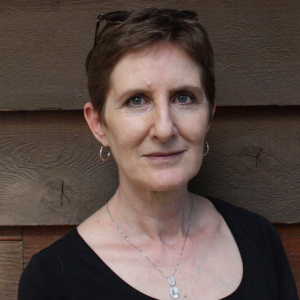 Gerri Brightwell’s fourth novel, "Turnback Ridge", was published in 2022.
Her short work can be found in Best Small Fictions 2023, Flash Fiction Online, The Best American Mystery Stories 2017, Alaska Quarterly Review, and many other venues.
Her flash has been on Wigleaf’s Top 50 Very Short Fictions in 2021 and 2025.
She teaches at the University of Alaska, Fairbanks, USA.





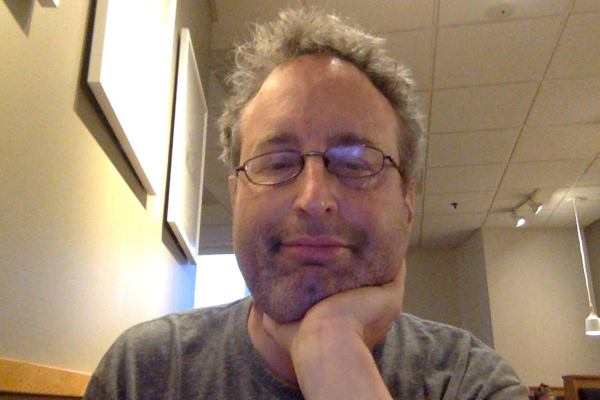
 Alistair Lloyd is a Melbourne based writer and narrator who has been consuming good quality science fiction and fantasy most of his life.
 Sarah Jane Justice is an Adelaide-based fiction writer, poet, musician and spoken word artist.
 Mark is an astrophysicist and space scientist who worked on the Cassini/Huygens mission to Saturn. Following this he worked in computer consultancy, engineering, and high energy research (with a stint at the JET Fusion Torus).
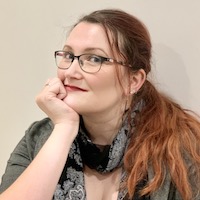 Emma Louise Gill (she/her) is a British-Australian spec fic writer and consumer of vast amounts of coffee. Brought up on a diet of English lit, she rebelled and now spends her time writing explosive space opera and other fantastical things in
 Barry Yedvobnick is a recently retired Biology Professor. He performed molecular biology and genetic research, and taught, at Emory University in Atlanta for 34 years. He is new to fiction writing, and enjoys taking real science a step or two beyond its known boundaries in his


 Tim Borella is an Australian author, mainly of short speculative fiction published in anthologies, online and in podcasts.
 Geraldine Borella writes fiction for children, young adults and adults. Her work has been published by Deadset Press, IFWG Publishing, Wombat Books/Rhiza Edge, AHWA/Midnight Echo, Antipodean SF, Shacklebound Books, Black Ink Fiction, Paramour Ink Fiction, House of Loki and Raven & Drake
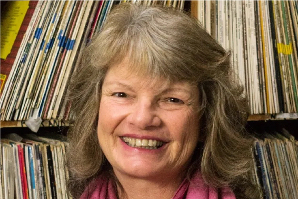 My time at Nambucca Valley Community Radio began back in 2016 after moving into the area from Sydney.
 Merri Andrew writes poetry and short fiction, some of which has appeared in Cordite, Be:longing, Baby Teeth and Islet, among other places.
 Brian Biswas lives in Chapel Hill, North Carolina, USA.
 Tara Campbell is an award-winning writer, teacher, Kimbilio Fellow, fiction co-editor at Barrelhouse, and graduate of American University's MFA in Creative Writing.
 Ed lives with his wife plus a magical assortment of native animals in tropical North Queensland.